Becoming an Arborist

Sometimes in working on a family tree you inevitably come across a false trail. This first occurred when my mother gave me the incorrect name of her mother’s father. At that time it was more time consuming to get certificates and when my grandmother’s birth certificate arrived – surprise, surprise – a different father! A minor set back but new research got me on the right track. That’s when I knew i had to get the three key certificates – birth, marriage and death.

But sometimes even that does not help. A spanner could get tossed in the roots of your family tree which is what happened with my grandfather – John Henry Green. There was a number of coincidences that came with John’s story.

My original history had John Henry, born to Thomas and Eliza Green in 1866. This was confirmed with the birth certificate. I was able to follow John’s life through the census returns to 1894 when Johnny married Ellen Ethel White. The marriage certificate confirmed that John Henry, who’s father was Thomas married Ellen Ethel White. Good so far. A minor difference – Thomas was listed as a railway worker and by the time of the marriage Thomas was working as a farm bailiff but he had been a railway worker.

For the marriage certificates of his daughters, John Henry was there as a railway ticket inspector. Then, for the marriage of his youngest daughter he was going by Henry John??? The 1939 registration also listed him as Henry John but the rest of the family was listed and correct. The register shows Henry john as being born in 1866.

I had been working on trying to find that third certificate – the death certificate. Through electoral registers Henry John was listed as 54 Woodstock Road up until 1950 but then he disappeared in 1951. Time to expand my search for John Henry/Henry John and a likely candidate was Henry J M Green who died in 1950.

When I received the death certificate for a Henry John Mantell Green my tree branch started to shake. Henry lived at 54 Woodstock Road. The informant was C.H. Green, his son and my great uncle was Cyril Henry Green. To cap it off, Henry was a retired railway inspector.

The chainsaw was warming up.

Mantell sounded like a surname, usually on the mother’s side and there was a birth registration for Henry John Mantell Green and when I tracked that down, his father was Thomas Green – a railway employee. And Thomas Green married Mary Elizabeth Mantell. The chainsaw is ready.

As an added twist, poor Mary died in ’69 when Henry was three years old and like so many of my other relatives, Thomas then married another Mary.

Henry John Mantell Green went by John Henry from 1881 through to 1932 and then changed back to Henry John. It appears to be around the time he retired from the railway.

[deep sigh] so, once again a certificate leads me down a different rabbit hole. The marriage certificate I have for John and Ellen is good but having a John Henry who worked for the railway whose father was Thomas and a Henry John who worked for the railway whose father was Thomas is comletely unacceptable. However, paper chips start flying as I cut John Henry and his ancestors free and I graft Henry John and his ancestors on my tree.

Lesson here – much as we do not like making or acknowledging mistakes in our work, it happens. Recognise and correct the mistake aand keep on going!

If you have any questions or need help drop me a line at cormorant_art@yahoo.ca or leave a message on this blog.

Cheerio for now.

Replacement Actors

How many of you remember Bewitched and the infamous Darren vs Darren switch? Dick York had to pull out due to back issues in season 6 and he was replaced by Dick Sergeant with no  explanation or comment.

Rosanne also replaced a character. The actress playing Becky, the eldest daughter was replaced. The show decided to make a spoof of this with the youngest child constantly commenting the new actress was NOT his sister!

Why is this part of a genealogy blog? Seems at least two of my ancestors were ahead of their time.

John Beavan married Sarah Llewellan in 1824. It looks like Sarah died in 1848 (waiting for cert to confirm) and John then married Sarah Ridgway in July of 1849. Would this be confusing to the seven children? Did John convince old friends that Sarah2 was the same as Sarah1? Or did he just like the name Sarah?

James Skipper married Eliza Riches in 1860. Eliza passed away giving birth to their son, Robert in 1873. At least James waited a couple of years before marrying Eliza Medlock in 1876.

In John Beavan’s case I received a death certificate for Sarah Beavan but the informant was a brother Josiah Ridgway??? In checking John’s death, Josiah was again the informant. Who was this guy? I found reference to John Beavan marrying Sarah Ridgway so ordered the certificate. John, a widower married Sarah and her brother – Josiah was a witness.

Bottom line is don’t assume your ancestors remained married to the same person throughout their life. Request certificates and wade through the information. There are mysteries to be solved out there!

The missing triplets

When you are looking at the census records for your ancestors you might not be getting the whole story, especially with regards to any children.

When I am looking for offspring of my ancestors I use a number of different sources. The census records are a start and the General Registry Office (GRO) in the UK is a help. Of course the ability to study and interpret the census records is an important step and so, the story of the missing triplets.

One of my ancestral lines is the White family and the time period we are going to look at is between 1861 and 1871. The usual first step is to review the 1861 census records:

The Whites were living in Romford, Essex. There was Joseph and Sarah and the two children, Joseph (4) and Louisa (1). As a side note their other son, Thomas (3) was staying with relatives.

1861 census, Romford Essex

The next decade, 1871 we find the Whites in Buckhurst Hill, Essex. Joseph appears on the previous page but for the purposes of this exercise I have copied both Sarah and the children at home.

1871 census

In reviewing the children of Joseph and Sarah (including those not present on the 1871 census) we have:

Joseph (1856), Thomas (1858), Louisa (1859), Henry (1861), Alice (1862), Edward (1864), Frank (1866), Mary Ann (1867) and then Ellen (1871). Seems good but what is missing? If you look you will see that the Whites seem to have a child every two years or so except between Mary Ann, born in January of ’67 and Ellen, born in September ’71. This is a 4 ½ year gap. Why?

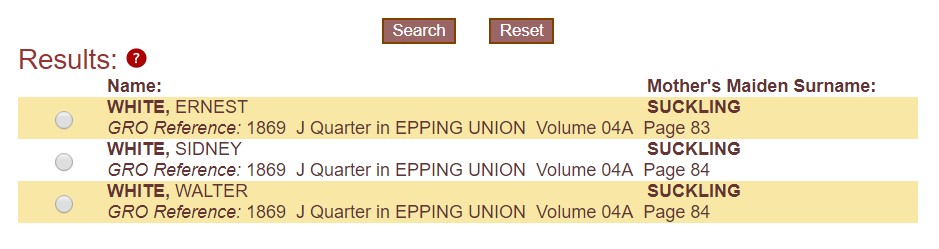
If we were talking about a serial killer (and we’re not) the general theory is that Joseph was either away or incarcerated until 1871. Don’t worry, he was neither. This leads me to the GRO indexes. We know Mary Ann was born in Buckhurst Hill as was Ellen so my search begins between 1868 and 1870. The registration district is Epping. Unfortunately the indexes must be searched by sex but you can also add the mother’s maiden name. In searching the males born between 1868 and 1870 whose mother’s surname is Suckling we get:

triplets birth

Are all these boys related? It would seem so but I do not like assuming so I ordered the birth certificates which confirmed they are mine, or rather their sons. The next question was what happened to the boys? Back to GRO indexes for deaths:

white gro death

Each name had to be searched individually with the same result then I ordered the death certificates. And finally, the story of the missing triplets.

The triplets – May 10th, 1869 and Sarah was to give birth. Joseph was still working as a coal agent and the family had eight children so far. Sarah had been told this was to be a multiple birth and in the afternoon she went into labour. Sarah gave birth to not one, not two but three baby boys but they were small and weak. The Whites were to name the boys Ernest, Sidney and Walter. But unfortunately the boys did not survive. Ernest was born first at 1:30pm, followed by Walter and finally Sidney, at 2:30pm. Total labour lasted approximately one hour which is certainly an indication of how small the babies were. All the boys were listed as being 2 ½ hours old at death and the cause of death was listed as inanition.

Inanition is a quality or state of being empty. It is the exhausted condition that results from lack of food and water. But these were newborns! In all likelihood, they would have been starved in the uterus. Nowadays, with scans etc. mothers are delivered early if the fetus is not growing (intra uterine growth retardation) and the baby is then taken to Special Care Baby Unit until strong enough to go home. In 1869 the baby or babies in this case would have either been born premature and very small and unfortunately very weak.

While Sarah was recovering Joseph had the sad task of going to the registrar on May 13th and registering both the births of his sons and the deaths of his sons.

After this tragedy the Whites had another child. Frederick White was baptized June 20, 1870 in Buckhurst Hill. Joseph was working as a shopkeeper and coal agent. Frederick passed away in early 1871 and was buried on January 13, 1871. Frederick was only seven months old.

Verifying an ancestor – birth records (part 3) – Birth Registrations, United Kingdom

This is the last of 3 parts about verifying your ancestors through the various birth records.

In 1836 the General Registration Office was founded and civil registration began in 1837. The need for this office was due to the increase in nonconformity and a gradual relaxation of laws against Catholics and other dissenters. More and more baptisms and marriages were going unrecorded.

In the early years it was up to the local registrar to find out what births, deaths and marriages had taken place and it has been estimated that only 50 – 60% of births were registered as parents were not legally required to inform the registrar. It was not until 1875 that the “Births and Deaths Act” made registration mandatory.

Births had to be registered, usually by the mother or father within 42 days. There was a fee imposed for late registrations which may have caused some parents to lie about the actual birth date. Until 1926 there was no registration for still-born children and sometimes if a child was sickly the parents held off registering the child in case the child dies, even though he/she was not still-born. This does not stop the parent from having the child baptised though.

Birth Registrations information includes:

  • Birth date and place (usually an address and town). In some cases, if the child was not born at home there might be a time recorded.
  • Child’s name and sex
  • Father’s name and surname
  • Mother’s name, surname and maiden name
  • Occupation of father
  • Informant’s name and relationship to the child
  • Date when registered

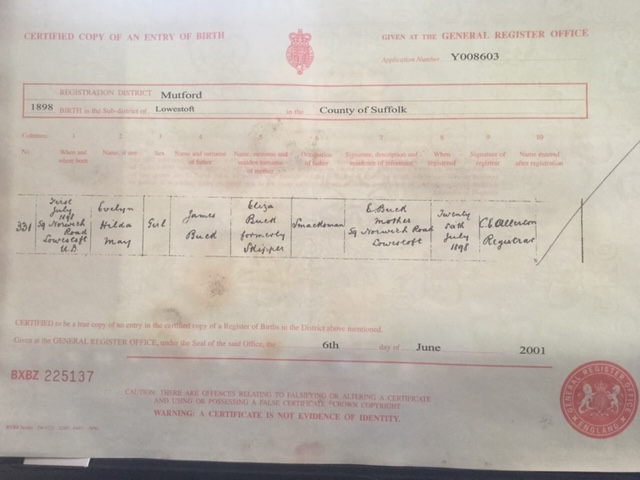
I have included Evelyn Hilda May Buck’s birth registration. As I mentioned previously, my mother was sure Evelyn’s father was a Joseph Buck but when I received the certificate the truth was there – James Buck!

evelyn hilda may buck

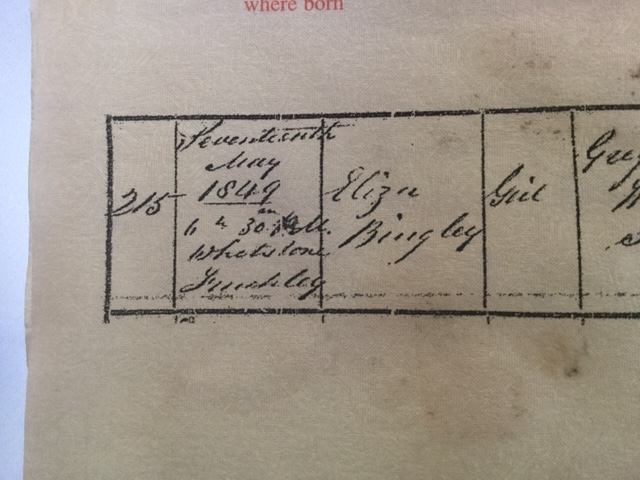
The other example is Eliza Bingley Smith’s birth certificate as it does show a time.


eliza close up

As you can see, some Registrar’s need a course in penmanship!

Back when I started things were not online as much as now and I had to send a request for the registration and waited for snail mail to deliver me the certified copy. Now I can go online to www.gro.gov.uk to order birth and death certificates and they send a PDF copy within 7 days. So much easier!

I would recommend that you get a copy of the birth registration for any direct ancestors you have to verify the connection as well as provide you with additional information the registration can provide.


Verifying an ancestor – birth records (part 2) – British Parish records

As mentioned, prior to 1837 it was the Churches that kept track of Births, Marriages and Deaths in their particular parish. We are going to concentrate on the birth records first, or should I say the baptism / christening records, depending on the Church.

These events were recorded on blank pages in a bound register and prior to about 1754 all in one volume. I had fun going through one parish where the early entries (late 1700s) were all in Latin! After 1754, a law was passed stating that marriages be recorded in a separate book and by 1812 there were preprinted registers available. This made for some consistency in information being recorded.

Beginning in 1598, copies of entries from many parishes were copied and sent annually to the bishop for the diocese of that area and these copies are known as Bishop’s Transcripts. If possible, try and look at both records as some information may be found on one and not the other.

Information you find will depend on a particular parish and even the Vicar and what the parents tell them. This is also where the variants in the spelling of the surname may arise. And we have to deal with the penmanship of the scribe.

Baptism registers usually contain:

  • Child’s name
  • Father’s name, and after 1813 usually his occupation and residence
  • Mother’s name, sometimes her maiden name
  • Baptism date, sometimes birth date

As you can see there are quite a few “sometimes” here. And I did come across a couple of baptisms where there was the mother listed but no father. This does pose a problem for the parish as it is up to the father to provide for the family and he could be charged a fine. I had suspicions about the father, a married man and when I checked the marriage registrations later for the children, his name was there.

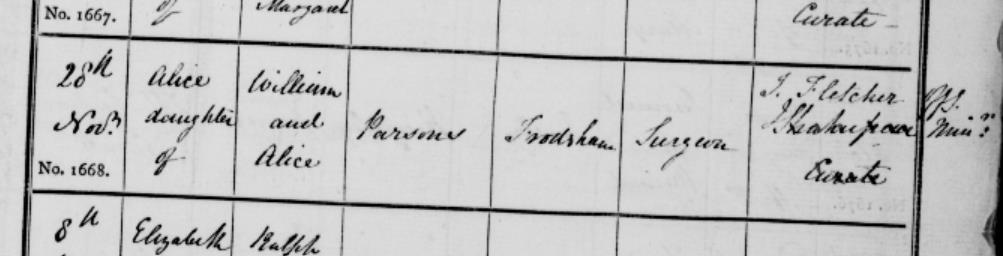
alice baptism

So, in Alice’s case we know she was baptised on 28th Nov 1822 (I did not copy the top of the page but that is where the year is listed). Her father was William Parsons, lived in Frodsham and was a surgeon. Her mother was Alice. While it does give us the baptism date, we still do not know the actual birth date. In Alice’s case and that of her siblings I have only been able to record the baptisms but it does give us an idea.

Scrolling through the registers may also help find missing children. Same parent names, same occupation, same town/village is a good indication. My primary source to start building a family has been the census records that were taken every ten years but if a child had been born and died between censuses then the registers will help. Cross check and baptisms to deaths to double-check.

There is no timeframe as to when the child had to be baptised. I have one family where six members were all baptised on the same day with a note for two of them being “adult baptism” and another where four of the children were baptised at the same time but had various years of birth.

The copy below does show the top of the preprinted register with the headings. As you can see, the first entry does include birth information. This would be a side note or entry below as there is no column for birth information.

baptism sample

For the records I have found that I flip and cross-reference between two main sites:

www.ancestry.ca (.ca because I’m in Canada but it provides information from around the world, also a .com or .uk) and www.findmypast.com as they have good databases of records, some found on one and not the other, then its screen grab as necessary. The downside is both of these sites are paid sites. There are free sites but they will not provide as much detail.

Part 3 will be Birth registrations after 1837.

Verifying an ancestor – birth records (part 1)

I found out early that it is best to get an actual copy of either a birth registration or a baptism record in order to claim a person as a member of your family tree. See my earlier post regarding my grandmother, Evelyn Buck.

Prior to 1837, only Churches recorded birth, marriage and death information in England. By 1837 the Government realized there was a need for more accurate records for voting, tax and defense purposes and created the General Registry Office to cover births, marriages and deaths (BMD). They began the new registration process on July 1, 1837.

Prior to looking at the records, a quick word on naming patterns in early British families. While the following is not a requirement, I have found that most of my ancestors, especially the earlier families, have followed the same pattern below so names do provide clues, either first or middle names.

The most common convention was for the parents to choose names that honored people. Sometimes the people  honored were powerful people, such as a local, wealthy landowner. Sometimes the names honored royalty. So there were many Henrys named after King Henry and many Georges named after King George. The most common persons to honor, however, were the gender appropriate grandparents and parents.

While the idea may seem a bit morbid to our tender ears, a child’s untimely death meant the end of the honor bestowed upon someone. Since many children died in the 17th and 18th centuries, parents had no problem with re-using the name of a dead child for a subsequent birth. In my Buck family, a particular branch had four Robert Bucks prior to the last surviving past childhood. How do you explain to the poor boy that the previous three Roberts all died young?

There was even a convention in the order in which the ancestors were honored – probably to avoid insulting anyone. Although it was far from universally used, the usual British naming convention was as follows:

  • The first son was named after the paternal grandfather
    • The second son was named after the maternal grandfather
    • The third son was named after the father
    • The fourth son was named after the oldest paternal uncle
    • The fifth was named after the second oldest paternal uncle or the oldest maternal uncle
  • The first daughter was named after the maternal grandmother
    • The second daughter was named after the paternal grandmother
    • The third daughter was named after the mother
    • The fourth daughter was named after the oldest maternal aunt
    • The fifth was named after the second oldest maternal aunt or the oldest paternal aunt

The above does create some difficulties for genealogist as you may find multiple people with the same name possibly even in from the same town or village so documents are necessary to get the right direct relative as opposed to a cousin or uncle or aunt.

As mentioned, the above is not cast in stone. When checking on my gg-grandfather, I entered his name in www.findmypast.com one day and to my surprise found a second Gregory Charles Willoughby Smith having been born in 1860 Dumfires, Scotland who died in 1861. Scotland records lead me to James Thomson Smith, Gregory’s brother! I am still working on the reasoning behind the names as Gregory’s father was John and his father was Archibald. Gregory was named after his mother’s father. Possibly there is a significant Charles Willoughby in our past. The Thomson came from the paternal grandmother’s maiden name.

Part 2 will look at baptism records.

Finding information

Hope every one is finding success with their various hunts. I thought I would spend the next couple of entries going through the standard sources I use to find and verify ancestors. I generally do not like claiming an ancestor until I have multiple connections. This week, mainly because of some fun I had tracking a great-great Aunt I thought I would touch on the annual census information from Great Britain.

In 1840 there was an Act passed by British Parliament in order to officially take an account of the total number of persons within the Kingdom of Great Britain.

In every census year an enumerator delivered a form to each household in the country for them to complete. The heads of household were instructed to give details of everyone who slept in that dwelling on census night, which was always a Sunday. The forms completed by each household, known as schedules, were collected a few days later by the enumerator. From 1841 to 1901 the information from the schedules was then copied into enumeration books. Once the enumeration books had been completed, most household schedules were destroyed, although there are some rare survivals. It is the enumeration books that we consult today online or on microfilm.

The 1841 census was the first to list the names of every individual, which makes it the earliest useful census for family historians. However, less information was collected in 1841 than in later census years. This first official census listed first name and surname, age (rounded down to nearest five years for those aged 15 or over), sex, occupation. It also included whether the person was born in the county where they were enumerated, this was a simple yes or no so if the answer was no there is no indication of where they might have been born. The other information recorded was whether they were born in Scotland (S), Ireland (I) or Foreign Parts (P).

There was a penalty for anyone refusing to answer, or wilfully giving a false answer to the questions. For every such refusal or wilfully wrong answer the person completing the forms would forfeit a sum not more than five pounds nor less than forty shillings, at the discretion of any Justice of the Peace.

One of the issues that had to be faced was the literacy of the person completing the census or lack thereof. Sometimes the enumerator was the one to complete the schedule based on answers provided.

While there may be earlier records around, most census information prior to 1841 were lost. The dates of the census for each decade were:

6 June 1841

30 March 1851

7 April 1861

2 April 1871

3 April 1881

5 April 1891

31 March 1901

2 April 1911

19 June 1921. Expected to be released by The National Archives in January 2022

Generally, for privacy reasons the census information is not released until 100 years have passed. A slight exception to this was the 29 September 1939 registry but entries have been redacted (blacked out) for potential people still living.

If you are lucky enough to have an ancestor with an unusual name then searching the returns online is fairly straight forward. Such was the case for me. My grandfather X 3 was Gregory Charles Willoughby Smith and he used his full name on every return! Bonus considering how many Smiths there were.

But sometimes it is a challenge. I recently started tracking my Rance ancestors for a book I am writing and have a great great Aunt Emma who seemed to disappear from the census schedules between 1871 and 1881. Now, this could mean she died or went overseas or was not home at the time of the census but she did show up in the 1891 census as living in Yorkshire working as a milliner and shopkeeper. She was single so where was she between 1861 and 1891? Time to play detective.

From an online genealogy site I was able to determine she was living in Flamborough, Yorkshire in 1879 and in 1889 so what about the 1881 census?

You have to keep in mind that some people’s penmanship is dubious at best and if the enumerator was the one completing the schedule then spelling could be an issue. Now add to that the interpretation of the transcriber and the room for error increases. What to do? Start with what you know – in my case I knew Emma Rance was born in 1844 in Ealing, Middlesex. I found out she was in Flamborough, Yorkshire in 1879 and 1889 and living at the same house so it was likely she was there in 1881. Online searches are wonderful. By entering first name Emma, birth year 1844 +/- 2 years and living in Flamborough I found an Emma Rowe living at the correct address, doing the same job, born in Ealing the same year. Looking at the original scan of the return and the writing being what it was but also knowing what I was looking for and the surname Rowe is clearly Rance. 1881 accounted for.

Using the same procedure for 1871 but not putting in the location as I did not know where she may have been, I found an Emma Rand working as a female servant for a Sarah Cook, milliner! Quick check of the form and Rand is a sloppy Rance.

Point of all this is do not give up. You may need to get creative and then find corroborating facts but truth be told, sometimes they just do not want to be found. It does make it exciting when you do find them though.

Happy hunting!

If you have any questions or want someone looked up I would be glad to help as much as I can.

Latest on my searching

Sometimes you come across stories from the past that are heart breaking. I recently came across the brother of a direct ancestor (so an uncle of sorts) who lost four children in the month of April 1889! I am researching to see what might have caused this – there was a cholera outbreak in England around then so I have requested a copy of a death certificate for one of the children to see what cause of death is listed.

Even more heart breaking – I found the baptism register for the parish where the family lived and there were four more children of various ages baptised that month and year, one of which died a few months later. Makes me wonder if all the children were sick or dying and the family frantically had the sick ones baptised before something happened to them.

You might find things like this and it brings to mind what our ancestors may have been going through in their lives.

Organizing your information

Hopefully you’ve been able to gather some information from various family members and you possibly are either very organized with notes in binders (yes, some people still use actual paper) or if you’re like me you may have scraps of information here, there and everywhere. But wait, there is software for that information that will help create your family history! Of course there is.

I use FamilyTree Maker software, mainly because when I started that was one of the only genealogy software programs available. I like the features available, the ease of use and the ability to create ancestor or descendant trees and reports for however many generations you want.

The program will advise about obvious errors like trying to enter a death date before the person was even born ( I did that) but other than that there are no warnings regarding what you put in. It is easy to correct entries whether it be a name or date and there is a warning before changes take place.

I back up my information to both my laptop and a USB stick every day I have put new data in and the program makes it easy to save and retrieve information. You can also sync your family tree to the Ancestry app which allows information sharing and provides you with hints about possible ancestors that have been input by other people. But remember, these are hints and you should verify information as much as possible before claiming it as part of your tree.

If you google search “genealogy software” there are reviews available of the various software tools available online. The website I looked at did ut FamilyTree Maker as best for beginners but it is pricier than other programs. You might see references to GEDCOM files. GEDCOM stands for Genealogical Data Communication. It is the uniformly accepted method of formatting family tree data into a text file so it can easily be read and converted by any genealogy software program.

Find a program that works for you and start inputting your tree!

Start with what you know, or think you know

So, if you are reading this either you clicked the wrong button or you are interested in finding out about your past – or, you’re stalking me.

I have spent the last week going through the parish registers for Essex searching for family. I did find out that in 1500s the parish registers were all written in latin, et notum fuisset!

The first thing I did and recommend you do is to ask questions – of your parents, grandparents, uncles, aunts, cousins, people with same last name even the internet. Bit of a cautionary note – you may hit some brick walls like I did with my Dad, get false information, partial information or they may legitimately may not know. Do not despair.

My main experience has been with England with some side trips to Scotland and even India! My initial sources of information were (gulp) my Dad, my mother and my Dad’s mother. Alas, my other grandparents had died well before I was born.

There were snippets of information from my grandmother which didn’t really connect but did serve as some guide points along the way. Much as my dad would not talk about his immediate siblings or father there were even glimmers there – his maternal grandfather worked for the railway and was a guard on the Royal Scotsman (turned out to be the Flying Scotsman of the LNER) and his name was John Henry Green.

One of the things he did volunteer was that we are related to Lord Horatio Nelson! Every time there was a picture of Trafalgar Square with the Nelson monument in the middle he would say “We’re related to him!” Allegedly all written down in the “family bible” whereabouts unknown. Tidbits of information but write them all down, who knows what’s real and what’s imagined. Nelson’s mother’s maiden name was Suckling ergo the parish registers I was going through.

Then there was my mum. Bless her, she was trying to be helpful. Her dad was Joseph and her mum was Evelyn – good start. She even knew her mum’s father’s name – Joseph Buck. Wow, guess I’ll start with mum’s side. I’ll go through what tools are available now but when I started it meant a trip up to the local Family History Centre run by the Church of Latter Day Saints, open on Tuesdays. Scroll  through reels and reels of microfilm, make notes, order other reels of microfilm and impatiently wait until they arrive and repeat. Use the internet and pull up whatever genealogy information was available. I even have a complete copy of the British 1881 census on CDs (my laptop doesn’t even have a CD port anymore).

Bottom line, I found out all about granddad Buck from Lowestoft, Suffolk. How he skippered a barge for the Coleman Mustard Company. Such a bright yet naive start. I decided to order a copy of Evelyn’s birth certificate. Alas, in the stone age of family research I had to order a copy online then wait patiently for snail mail, sail mail and back to snail mail until I received an envelope in the mailbox! Christmas all over again. Opening the envelope and slowly pulling out Evelyn Hilda May Buck’s birth certificate (or certified true copy) and there written for the world to see, her mother’s name – Eliza Buck and her father’s name – JAMES Buck!!!!!!! What?

Went back to my mum, how could this happen? How did you have the wrong name for your grandfather? Well son, a while ago my sister Betty saw an ad in the paper saying that Joseph Buck from Lowestoft had died and any one having a claim to his estate should contact the undersigned immediately. Her mum was from Lowestoft, her last name was Buck so that must be her father! Urg. If anyone out there wants information on Joseph Buck just let me know, I’ll be at the Family History Centre scrolling through reels and reels of microfilm. I should have been suspicious when my mum did not know that my Aunt Marina went by her middle name and not her first name, Isobel. “Really, her name is Isobel?” I guess with twelve kids in the family it would be hard to keep track.

Bottom line, write everything down. There will be unexpected side trips but just keep digging. Next post we can talk about what is available to keep track of all this information. I would be interested if anyone wants to share their miscues along the way or if you have any questions, make a comment.

As a side note, I have managed to get my mum’s Buck family back to 1770 – so far.